
A single telehealth billing mistake such as using the wrong modifier or misunderstanding payer rules can lead to claim denials, delayed reimbursements, compliance violations, and revenue loss. As virtual healthcare continues to expand, providers must understand telehealth parity laws and proper modifier usage to reduce billing risks and maintain reimbursement accuracy.
One of the most common areas of confusion in telehealth billing is telehealth modifier 95 vs GT. Many providers struggle to understand the GT modifier vs 95, when to use each modifier, and how payer requirements differ. Because telehealth billing regulations continue to evolve, providers must stay informed to avoid costly compliance mistakes.
In this blog, we will explore the major compliance risks in telehealth billing, explain telehealth parity laws, compare Modifier 95 vs GT, and discuss best practices to improve billing accuracy and reduce reimbursement issues.
Understanding Telehealth Billing Compliance
Telehealth billing compliance means following federal, state, and payer-specific rules when billing for remote healthcare services. Providers must ensure telehealth visits are medically necessary, documented properly, and billed using the correct CPT codes, modifiers, and place of service (POS) codes.
Telehealth billing requirements may vary depending on:
- Medicare guidelines
- Medicaid regulations
- Commercial payer policies
- State telehealth laws
- Provider specialty and service type
Failure to comply with these requirements may result in denied claims, delayed reimbursements, payer audits, penalties, or regulatory concerns.
Because telehealth billing regulations frequently change, healthcare organizations should regularly review payer bulletins, state telehealth laws, and CMS guidance to stay compliant.
What Are Telehealth Parity Laws?
Telehealth parity laws determine whether insurance providers must cover and reimburse telehealth services similarly to in-person healthcare visits.
These laws typically fall into two categories:
1. Coverage Parity
Coverage parity laws require insurers to cover telehealth services if the same service is already covered during an in-person visit.
For example, if an insurance payer covers a behavioral health consultation in an office setting, that same service may also qualify for telehealth reimbursement.
2. Payment Parity
Payment parity laws determine whether providers receive the same reimbursement amount for telehealth services as they would for face-to-face visits.
However, reimbursement rates vary significantly depending on payer contracts and state laws. Some states require equal reimbursement, while others allow insurers to establish independent telehealth payment policies.
Because telehealth parity laws continue to evolve, providers should always verify payer-specific reimbursement policies before submitting claims.
Why Telehealth Parity Laws Create Compliance Risks
Telehealth parity laws create compliance risks because regulations are not standardized across all states and insurance payers.
Incorrect Reimbursement Expectations
Some providers assume telehealth visits are always reimbursed at the same rate as in-person care. In reality, reimbursement policies differ by payer and state regulations.
Billing under incorrect reimbursement assumptions may cause payment delays or underpayments.
State-by-State Differences
Telehealth laws vary significantly across states. Billing practices compliant in one state may not align with regulations in another.
Healthcare organizations operating across multiple states are especially vulnerable to compliance inconsistencies.
Temporary Policy Changes
Many telehealth flexibilities introduced during public health emergencies changed after emergency periods ended. Some policies became permanent, while others expired.
Practices relying on outdated telehealth billing processes may unintentionally create compliance risks.
Documentation Gaps
Telehealth encounters require detailed documentation, including:
- Patient consent for telehealth services
- Type of communication platform used
- Clinical documentation supporting medical necessity
- Duration of the encounter when required
- Provider and patient location if payer policies require it
Incomplete records increase audit risks and reimbursement denials.
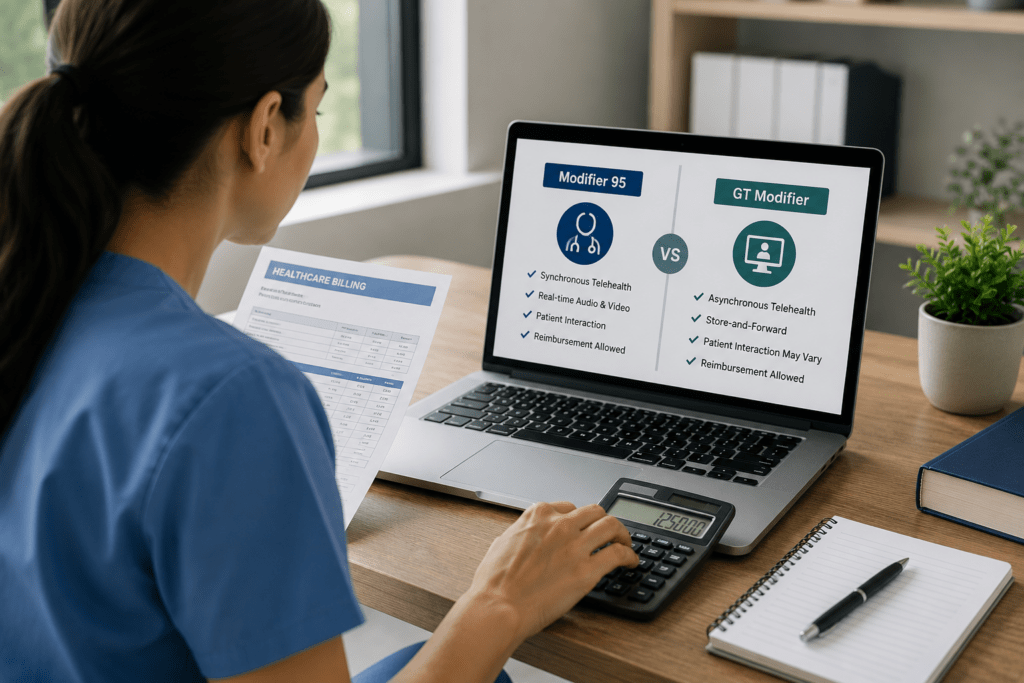
Telehealth Modifier 95 vs GT: Understanding the Difference
Correct modifier usage plays a critical role in telehealth billing compliance. One of the most searched billing questions today is telehealth modifier 95 vs GT and whether both modifiers can be used interchangeably.
The short answer is no.
Understanding GT modifier vs 95 modifier requirements is essential because payer policies differ.
What Is Modifier 95?
Modifier 95 indicates that a healthcare service was provided through a real-time interactive audio and video telecommunication system.
This modifier is widely accepted by Medicare and many commercial insurers for eligible telehealth services.
Modifier 95 is commonly used when:
- The patient and provider communicate through live video
- Telehealth services meet payer requirements
- Approved CPT codes are used for virtual care billing
Examples include:
- Evaluation and management (E/M) visits
- Behavioral health visits
- Follow-up consultations

What Is Modifier GT?
Modifier GT means the service was provided via interactive audio and video telecommunications systems.
Historically, Modifier GT was widely used for telehealth billing. Today, it is less commonly used by Medicare but may still be required by certain Medicaid programs and commercial insurance payers.
This is where confusion around the GT modifier vs 95 becomes a compliance concern. Providers should not assume both modifiers are interchangeable because payer requirements often differ.
GT Modifier vs 95 Modifier: Key Differences
| Feature | Modifier 95 | Modifier GT |
| Purpose | Telehealth via live audio-video | Telehealth via audio-video |
| Medicare Usage | Commonly accepted | Limited usage |
| Commercial Payers | Frequently used | Some still require GT |
| Medicaid | Depends on state | Still used by certain programs |
| Compliance Risk | A wrong modifier may deny claims | A wrong modifier may deny claims |
When comparing telehealth modifiers 95 vs GT, the biggest takeaway is simple: always confirm payer requirements before claim submission.
Using Modifier 95 when a payer requires GT—or billing GT when Modifier 95 is required—may result in denied claims, reimbursement delays, or compliance issues.
Common Compliance Risks in Telehealth Billing
1. Incorrect Modifier Usage
Improper modifier selection remains one of the biggest telehealth billing risks.
Providers should verify whether payers require the following:
- Modifier 95
- Modifier GT
- Modifier GQ in limited situations
- No modifier at all
Understanding GT modifier vs 95 modifier requirements can help practices reduce preventable denials.
2. Wrong Place of Service (POS) Codes
Incorrect POS coding may negatively impact reimbursement.
Common telehealth POS codes include:
- POS 02: Telehealth provided outside the patient’s home
- POS 10: Telehealth provided in the patient’s home
POS requirements may vary based on payer contracts and telehealth coverage guidelines.
3. Failure to Verify Payer Policies
Telehealth billing rules frequently change.
Some payers may:
- Require prior authorization
- Limit covered telehealth services
- Restrict eligible provider types
- Require specific documentation
Failing to verify payer policies increases telehealth billing compliance risks.
4. Audio-Only Billing Errors
Not every payer reimburses audio-only telehealth services.
Billing video-based telehealth codes for phone-only encounters may trigger claim denials or payer audits.
5. Incomplete Documentation
Poor documentation remains a major compliance issue.
Providers should document:
- Visit type
- Communication method
- Medical necessity
- Clinical decision-making
- Telehealth consent
Missing information can create audit concerns and payment delays.
Best Practices to Reduce Telehealth Billing Compliance Risks
Healthcare providers can reduce telehealth billing risks through proactive compliance strategies.
Stay Updated on Telehealth Regulations
Telehealth policies change frequently. Providers should routinely monitor CMS guidance, payer bulletins, and state telehealth regulations.
Verify Modifier Requirements Before Billing
Never assume Modifier 95 and GT are interchangeable.
Always confirm telehealth modifier 95 vs GT payer requirements before claim submission.
Train Billing Teams
Routine billing education helps staff stay updated on:
- Coding changes
- Modifier requirements
- Documentation expectations
- Payer-specific billing rules
Conduct Internal Billing Audits
Regular audits can help identify:
- Modifier errors
- Documentation issues
- Coding inconsistencies
- Reimbursement gaps
Audits improve billing accuracy and compliance readiness.
How Revantage Healthcare Business Solutions Supports Telehealth Billing Compliance
Managing telehealth billing compliance can be challenging due to changing regulations, payer-specific requirements, modifier confusion, and reimbursement complexities. Revantage Healthcare Business Solutions helps healthcare organizations simplify telehealth billing through accurate medical billing, coding, denial prevention, claims management, and compliance-focused revenue cycle management solutions.
Our experienced billing specialists stay updated on payer-specific telehealth requirements, telehealth modifiers 95 vs gt, POS coding changes, documentation standards, and reimbursement regulations. Whether managing multi-specialty telehealth billing or reducing claim denials, Revantage Healthcare Business Solutions delivers customized RCM support tailored to provider needs—helping practices improve cash flow while maintaining compliance.
Final Thoughts
Telehealth continues to reshape healthcare delivery, but billing compliance challenges remain a major concern for providers. Understanding telehealth parity laws, payer-specific requirements, and GT modifier vs 95 billing rules is critical for avoiding denials and reimbursement issues.
Providers that stay updated on regulations, verify modifier requirements, improve documentation, and conduct billing audits are better positioned to reduce compliance risks and improve operational efficiency.
Frequently Asked Questions (FAQs)
What is the difference between Modifier 95 and GT?
When comparing the GT modifier vs 95, Modifier 95 is widely accepted for telehealth services provided through real-time audio-video communication, while Modifier GT may still be required by certain Medicaid programs and commercial payers.
Is Modifier GT still used?
Yes. Although less common for Medicare billing, some insurers and Medicaid programs still require Modifier GT.
Can incorrect modifier usage cause claim denials?
Yes. Incorrect use of Modifier 95 or GT can result in denied claims, delayed reimbursement, and billing compliance issues.
Are telehealth parity laws the same in every state?
No. Telehealth parity laws vary by state and payer, making compliance more complex for healthcare providers.
Why is telehealth documentation important?
Proper documentation supports medical necessity, reduces audit risks, and improves reimbursement accuracy for telehealth claims.