
The behavioral health industry faces unique challenges in billing, particularly with regard to CPT codes for psychotherapy. Inconsistent documentation, improper timing of sessions, or incorrect group therapy billing could result in denied claims or delayed reimbursements. Increase the risk of compliance issues.
The most commonly misunderstood codes are 90834, 90837, and 90853. Many providers struggle to understand the difference between 90834 and 90837, the right time to use each code, and how to properly bill the 90853 sessions of group therapy. CPT code 90834 is used for individual psychotherapy sessions lasting 38–52 minutes.
If you are struggling with problems with denials, unpaid bills, or confusion about billing for psychotherapy, this guide will aid you in avoiding costly errors and improve the accuracy of reimbursement.
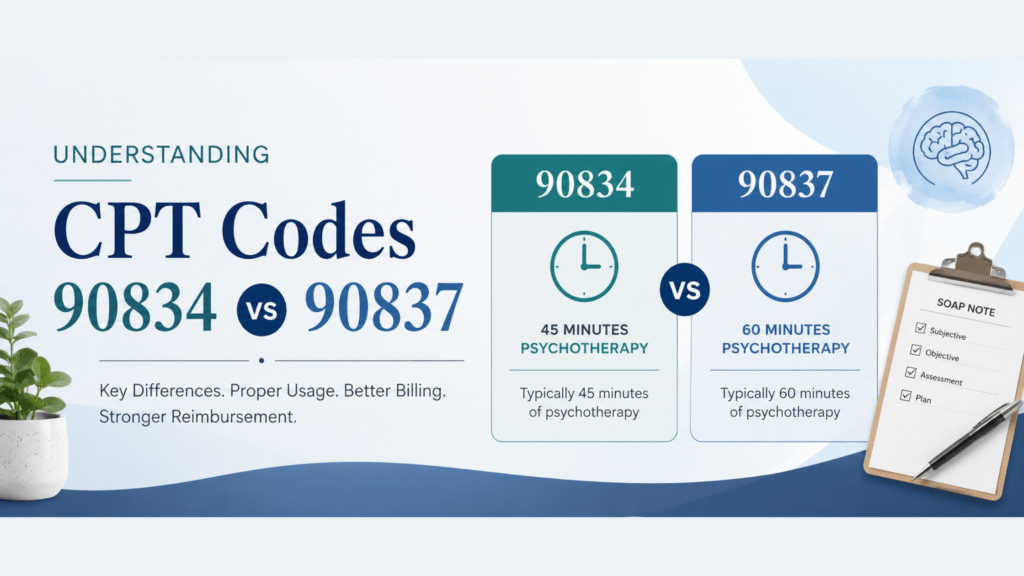
Understanding 90834 vs 90837
The distinction between 90834 and 90837 is mainly due to the time that is spent during psychotherapy sessions.
CPT Code 90834 – Psychotherapy, 45 Minutes
90834 is a method for private psychotherapy sessions lasting between 38 and 52 minutes.
This code is applicable to the moment a licensed mental health provider provides therapy services to a patient within that time frame.
Common use cases are:
- Sessions for anxiety treatment
- Counseling for depression
- Trauma-focused therapy
- Interventions for behavior
- Plans for ongoing psychotherapy
Providers frequently make billing errors by choosing 90834 because the appointment was scheduled to last 45 minutes instead of recording the actual face-to-face therapy session time.
CPT Code 90837 – Psychotherapy, 60 Minutes
90837 is used for psychotherapy sessions that last more than 53 minutes.
The code typically reimburses at a higher cost due to longer therapy sessions requiring an additional amount of time from the clinician and a higher level of complexity.
“90837” is a term that is used to describe the following reasons:
- Complex cases of behavioral health
- Mental health problems that are serious
- Sessions for crisis intervention
- The treatment for trauma requires an extended discussion
- Services for intensive psychotherapy
One of the most significant problems with 90837’s billing guidelines is the lack of documentation. Many payors look at the code due to its greater reimbursement rate.
90834 or 90837: What is the Major Difference?
The key difference between 90834 vs 90837 is the documented psychotherapy time.
| CPT Code | Session Length | Usage |
| 90834 | 38–52 minutes | Standard psychotherapy |
| 90837 | 53+ minutes | Extended psychotherapy |
Many behavioral health practices accidentally bill the wrong code due to poor documentation habits.
Many behavioral health clinics are unable to accurately bill the correct code because of poor documentation practices.
For example:
Therapists schedule an appointment for 60 minutes, but they spend just 47 minutes engaged in psychotherapy. In this case, billing 90837 could trigger a denial audit risk due to the fact that the actual billing time is aligned with 90834.
Always bill on the basis of the time of therapy that is documented instead of the scheduled length of the appointment.
Common Time-Based Billing Mistakes to Avoid
1. Billing Based on Scheduled Time Instead of Actual Therapy Time
This is among the most frequent mistakes in billing for behavioral health.
A 60-minute session does not necessarily mean that you are eligible for 90837. Documentation must justify the treatment time.
Incorrect example:
- Appointment scheduled: 60 minutes
- Actual therapy duration: 48 minutes
- Incorrect billing 90837
- Correct billing: 90834.
Failure to ensure that documentation is in line with CPT requirements can increase the risk of denial.
2. Missing Documentation Details
Behavioral health claims need strong medical documentation.
Notes should contain:
- Time for session start and finish
- Treatment goals
- Patient progress
- Medical need
- The use of therapeutic interventions
Payers often deny claims for psychotherapy because of the lack of validation for time.
3. Overusing 90837
Some practices accidentally trigger suspicions from the payers by overbilling 90837.
Since it covers more than 90834, insurance providers frequently look into the use of excessive therapy codes.
A pattern of repeated 90837-related billings without adequate documentation can lead to:
- Claim denials
- Audits
- Downcoding
- Payment delays
Clean behavioral health billing depends on accurate CPT coding and compliant documentation.
4. Ignoring Payer-Specific Requirements
Not every insurance provider follows the same set of guidelines.
Certain insurers will require the following:
- Prior authorization
- Review of documents
- Limitations on frequency for 90837 sessions
Checking payer guidelines before claim submission helps reduce denials.
What Is CPT Code 90853?
While 90834 and 90837 pertain to individual psychotherapy sessions, 90853 can be utilized for group therapy sessions.
90853 is group psychotherapy that is offered to multiple patients at the same time.
Patients take part in therapeutic discussions conducted by a licensed mental health professional.
- Some examples of 90853 services are:
- Substance Recovery groups for abuse
- Groups of Behavioral Health Therapy
- Support sessions for anxiety
- Groups of cognitive-behavioral therapy
- Mental health skill-building programs
However, billing for group therapy is not without the associated compliance risks.
Common 90853 Group Therapy Billing Issues
1. Billing 90853 Without Active Therapeutic Participation
The biggest mistake is to charge 90853 for classes that are educational or for passive attendance.
To correctly bill:
Patients should actively take part in a group therapy process, not just receive information.
For example:
Billable Group Therapy:
A therapist facilitates discussion, behavioral interventions, and therapeutic engagement among participants.
Non-Billable Activity:
A seminar-style education that is not based on psychotherapy intervention.
2. Poor Documentation
Incomplete documentation is the reason for frequent 90853 claim denials.
Your documents should clearly contain:
- The number of participants
- Group session goals
- Therapeutic interventions
- Patient participation level
- Progress towards the treatment goals
Without the proper notes, payors could deny claims due to not having enough medical need.
3. Billing 90853 With Individual Therapy Incorrectly
Some providers are struggling with billing 90853 with individual psychotherapy codes such as 90834 or 90837 on the same day.
In most cases, same-day billing is permitted only when separate, medically required services are documented.
For instance:
A patient goes to:
- One-on-one sessions with a psychotherapist (90837)
- Therapy group session (90853)
This could be reimbursable in the event that both services are clearly different and medically needed.
Untrue documentation is often the reason for delays.
4. Using 90853 for Family Therapy
Another common error is to confuse group psychotherapy with family psychotherapy.
90853 should be used only when patients who are not related participate in an exercise group.
Family sessions typically require a different psychotherapy CPT code.
Best Practices to Avoid Behavioral Health Billing Errors
The key to improving the accuracy of billing is a solid internal workflow.
Here are the proven methods to decrease denials
Train your staff on psychotherapy CPT codes.
Front desk team members as well as therapists and billing staff must be aware of the following:
- 90834 billing guidelines
- 90837 billing guidelines
- 90853 requirements for group therapy
A minor coding error could result in delays in reimbursement.
Improve Clinical Documentation
Notes on therapy that are detailed can help prove medical necessity and decrease the risk of audit.
The focus should be on:
- Session duration
- Interventions for treatment
- Patient engagement
- Tracking progress
- Therapy goals
Documentation is usually the decisive aspect between denial and payment.
Conduct Regular Billing Audits
The behavioral health professions benefit from monthly reviews of billing to find:
- Incorrect time-based code
- Missing documentation
- Modifier issues
- Denials to payors that are specific to the payer
Avoiding costly mistakes in the beginning helps protect revenue.
Verify Insurance Policies
Every payer could interpret different ways to pay for behavioral health services.
Verify:
- Coverage rules
- The authorization requirement
- Session limits
- Limitations on frequency
Being proactive can reduce the number of claims rejected.
Why Accurate Behavioral Health Billing Matters
Errors in billing in the field of behavioral healthcare can be a major source of revenue for a practice.
The incorrect code for 90834, 90837, or 90853 could result in the following issues:
- More denials of claims
- Delayed reimbursements
- Risks of compliance
- Insurance audits
- Revenue loss
Since billing for psychotherapy is heavily dependent on documentation and timing, providers must ensure that they are accurate throughout their revenue cycle.
How Revantage Healthcare Business Solutions Helps Behavioral Health Practices
At Revantage Healthcare Business Solutions, we are aware of the issues that providers of behavioral health have to overcome when it comes to psychotherapy codes and reimbursement.
Our special medical billing for behavioral health aid practices:
Reduce claim denials
Improve reimbursement rates
Check the accuracy of CPT code
Control compliance of payers
Streamline the revenue cycle for behavioral health management
If you’re having trouble with 90834 billing confusion or regular 90853 group therapy claims denials, our expert billing team can help you optimize the financial performance of your practice.
Frequently Asked Questions (FAQs)
What is the difference between 90834 and 90837?
The difference is based on psychotherapy duration.
- 90834: 38–52 minutes
- 90837: 53 minutes or longer
Providers should bill according to documented therapy time rather than appointment length.
Can 90834 and 90837 be billed on the same day?
Typically, providers bill only one individual psychotherapy code per session. Separate medically necessary services require proper documentation.
What is CPT code 90853 used for?
90853 is used for group psychotherapy sessions involving multiple patients participating in therapeutic treatment together.
Why are 90853 claims denied?
Common reasons include:
- Poor documentation
- Lack of medical necessity
- Incorrect session type
- Improper participant engagement records
Can 90853 and 90837 be billed together?
In some situations, yes — but both services must be separate, medically necessary, and fully documented.
Final Thoughts
Knowing 90834 vs 90837 is vital to prevent errors in time-based billing in the field of behavioral health. The accuracy of psychotherapy timing, the solid documentation, and compliance with payers all play an important role in reducing the number of denials.
Also, an appropriate group therapy bill in 90853 makes sure your practice is reimbursed without causing unnecessary issues with claims.
By enhancing documentation and partnering with seasoned behavioral health billing services experts to make sure they don’t make costly mistakes and concentrate more on providing care to patients.
Behavioral health providers face unique billing challenges, particularly with regard to CPT codes for psychotherapy. Small errors in documentation, improper session timing, or group therapy billing could cause claims to be denied, delay reimbursements, and increase the risk of not being in compliance.
The most commonly misunderstood codes are 90834, 90837, and 90853. A lot of providers are unable to grasp the 90834 vs 90837 and when to use each code and how to properly bill 90853 sessions of group therapy.
In the event that your clinic is suffering from delays, overpayments or confusion about billing for psychotherapy This guide can aid you in avoiding costly errors and increase reimbursement accuracy.