
When healthcare providers bill for office visits, selecting the correct Evaluation and Management (E/M) code is essential for compliance, reimbursement, and accurate documentation. Among the codes used for new patient visits, healthcare providers across medical specialties commonly report CPT 99203.
From primary care and internal medicine to specialty practices, many new patient encounters naturally meet the requirements of CPT code 99203 because they involve low-complexity medical decision-making and a moderate amount of provider time. Understanding when to use this code and how it differs from other E/M codes can help providers reduce claim denials and improve revenue cycle performance.
Quick Answer: What Is CPT 99203?
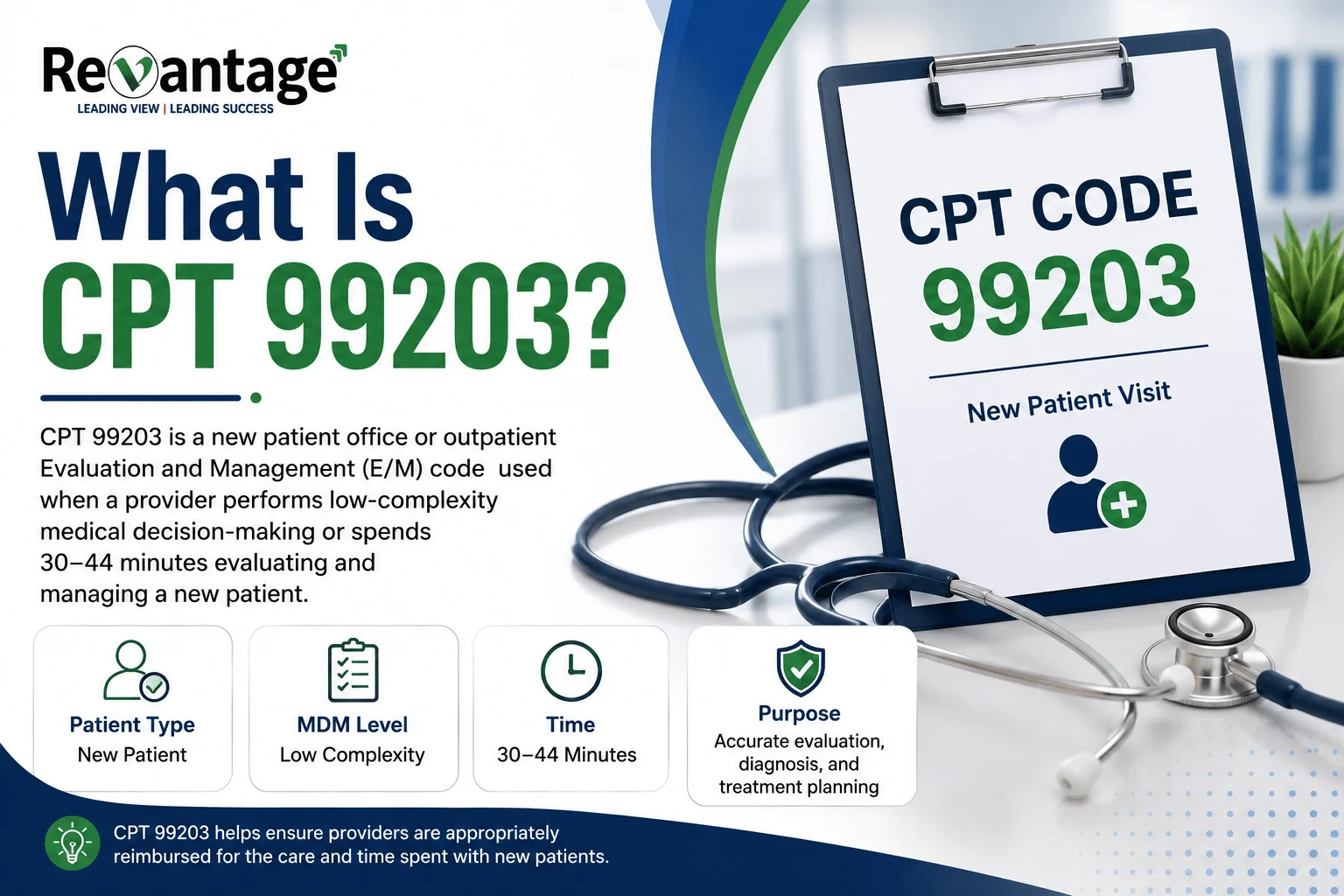
CPT 99203 is a new patient office visit code used when a healthcare provider performs low-complexity medical decision-making (MDM) or spends 30 to 44 minutes evaluating and managing a new patient in an outpatient setting. It is one of the most frequently used E/M codes because many routine new patient visits fall within this level of complexity.
What Is CPT 99203?
CPT code 99203 is an evaluation and management code used for a new patient office or outpatient visit. Under current E/M coding guidelines, providers may select the code based on either
- Medical Decision-Making (MDM)
- Total provider time spent on the date of service
The 99203 CPT code description applies when a provider evaluates a new patient and performs low-level medical decision-making or spends between 30 and 44 minutes on the encounter.
According to guidance from the American Medical Association (AMA), E/M coding focuses on the complexity of medical decision-making and total provider time rather than extensive documentation requirements, making code selection more clinically relevant.
99203 CPT Code Description
| Code | Description | Patient Type | MDM Level | Time |
| CPT 99203 | Office or outpatient evaluation and management visit | New Patient | Low | 30–44 minutes |
The procedure code 99203 is commonly used when patients present with conditions that require assessment, diagnosis, treatment planning, and follow-up recommendations without significant risk or complexity.
Why Is CPT 99203 So Commonly Used?
Several factors contribute to the popularity of CPT code 99203 among healthcare providers.
1. Many New Patient Visits Match Low-Complexity MDM
Patients frequently seek care for conditions that require evaluation and treatment but do not involve significant medical complexity.
Examples include:
- Hypertension
- Seasonal allergies
- Mild asthma
- GERD
- Skin conditions
- Joint pain
- Stable diabetes
- Upper respiratory infections
These scenarios often align perfectly with the requirements of the 99203 CPT code description.
2. Balanced Documentation Requirements
Unlike higher-level E/M services, CPT code 99203 does not require extensive documentation or highly complex medical decision-making. This balance makes it practical for many outpatient visits.
3. Appropriate Reimbursement
Providers often find that procedure code 99203 accurately reflects the work involved in evaluating many new patients while supporting appropriate reimbursement.
4. Alignment With Current E/M Guidelines
Since E/M coding reforms shifted the focus toward MDM and time, many encounters that previously required extensive documentation now naturally fit within the CPT 99203 level.
Read: Pap Smear ICD-10 Codes in 2026: When to Use Z01.419, Z01.411, Z12.4, and R87 Codes
Comparing CPT 99203 With Other New Patient E/M Codes
Understanding the differences between 99202, 99203, CPT code 99204, and 99205 helps providers choose the correct code.
| Code | MDM Level | Time | Typical Patient Scenario |
| 99202 | Straightforward | 15–29 minutes | Minor uncomplicated problem |
| 99203 | Low | 30–44 minutes | Stable chronic condition or uncomplicated illness |
| 99204 | Moderate | 45–59 minutes | Multiple chronic conditions requiring management |
| 99205 | High | 60–74 minutes | Complex patient with significant risk |

CPT Code 99202 Description
The CPT code 99202 applies to straightforward new patient visits involving minimal complexity and limited medical decision-making.
The 99202 CPT code description is typically appropriate for minor problems requiring simple evaluation and treatment.
CPT Code 99204 Description
The CPT code 99204 is reported when moderate medical decision-making is required.
The 99204 CPT code description generally involves:
- Multiple chronic conditions
- Prescription drug management
- Additional diagnostic testing
- Increased risk factors
99204 Time Requirement
Many providers ask about 99204 time requirements. When billing based on time, the provider must spend 45 to 59 minutes on the date of service.
CPT Code 99205 Description
The 99205 CPT code description represents the highest level of new patient office visits.
This code is typically used when:
- Medical decision-making is highly complex
- Significant health risks exist
- Extensive evaluation and coordination of care are required
The 99205 CPT code description also includes a time range of 60 to 74 minutes.
Documentation Requirements for CPT 99203
To support CPT code 99203, providers should document:
Chief Complaint
The reason for the patient’s visit.
Relevant Medical History
Including:
- Current symptoms
- Relevant past medical history
- Medications
- Family history when applicable
Examination Findings
A medically appropriate examination based on the patient’s condition.
Assessment and Treatment Plan
Documentation should clearly show:
- Diagnoses
- Clinical assessment
- Recommended treatment
- Follow-up instructions
Medical Decision-Making
The documentation should support low-level MDM through:
- Evaluation of stable conditions
- Assessment of uncomplicated illnesses
- Limited data review
- Low risk of complications
Time Documentation
When billing by time, providers must document total time spent on the date of service.
For CPT 99203, the required time range is
30–44 minutes
Example of CPT 99203 Billing
Consider the following scenario:
A new patient visits a family medicine physician for uncontrolled seasonal allergies and mild hypertension.
During the encounter, the provider:
- Reviews the patient’s history
- Evaluates symptoms
- Performs an examination
- Develops a treatment plan
- Discusses medication options
- Documents the visit
The total encounter time is 35 minutes.
Because the visit involves low-complexity medical decision-making and falls within the 30–44 minute time range, CPT code 99203 would generally be the appropriate billing choice.
Common Coding Errors to Avoid
Upcoding to CPT Code 99204
Providers should avoid reporting CPT code 99204 when documentation only supports low-level MDM.
Undercoding to CPT Code 99202
Using CPT code 99202 when the visit meets the criteria for 99203 may result in lost revenue.
Insufficient Documentation
Incomplete documentation remains one of the most common reasons for claim denials and payer audits.
Billing Based on Time Without Documentation
Providers must document total time spent if time is used to support code selection.
Why Accurate Use of CPT 99203 Matters
Proper reporting of CPT code 99203 can help practices:
- Improve reimbursement accuracy
- Reduce claim denials
- Strengthen compliance efforts
- Enhance audit readiness
- Support revenue cycle performance
- Improve coding consistency
Accurate E/M coding ensures providers are compensated appropriately for the services they deliver.
How Revantage Healthcare Business Solutions LLC Supports Accurate E/M Coding
Navigating E/M coding requirements can be challenging for healthcare organizations. Revantage Healthcare Business Solutions LLC provides comprehensive medical billing, coding, credentialing, and revenue cycle management services designed to improve claim accuracy and reimbursement outcomes.
Our experienced team stays current with evolving CPT guidelines and payer requirements, helping healthcare providers correctly report services such as CPT code 99202, CPT 99203, CPT code 99204, and 99205. Through proactive coding reviews and denial management strategies, we help practices strengthen compliance while maximizing revenue opportunities.
Conclusion
CPT 99203 remains one of the most commonly billed evaluation and management codes because it accurately reflects the level of care provided during many routine new patient office visits. Its combination of low-complexity medical decision-making, reasonable documentation requirements, and appropriate reimbursement makes it a practical choice for providers across numerous specialties.
By understanding the differences between 99202, 99203, 99204, and 99205, healthcare professionals can improve coding accuracy, maintain compliance, reduce denials, and optimize financial performance.
Frequently Asked Questions About CPT 99203
1. What is CPT 99203?
CPT 99203 is a new patient office visit code used for low-complexity medical decision-making or 30–44 minutes of total provider time.
2. What is the 99203 CPT code description?
It describes the evaluation and management of a new patient in an office or outpatient setting with low-complexity medical decision-making.
3. Is CPT 99203 for new patients only?
Yes. CPT 99203 is reported only for new patient office or outpatient visits.
4. What is the CPT code for a new patient office visit?
Common codes include 99202, 99203, 99204, and 99205, depending on complexity and time.
5. What is CPT code 99202?
CPT code 99202 is used for straightforward new patient visits lasting approximately 15–29 minutes.
6. What is the 99202 CPT code description?
The code represents a straightforward office visit requiring minimal complexity and limited decision-making.
7. What is CPT code 99204?
CPT code 99204 is used for new patient visits involving moderate medical decision-making.
8. What is the 99204 CPT code description?
It represents a moderate-complexity new patient evaluation requiring 45–59 minutes or moderate MDM.
9. What is 99204 time?
The required time range for CPT 99204 is 45–59 minutes.
10. What is CPT code 99205?
CPT code 99205 is the highest-level new patient office visit code.
11. What is the 99205 CPT code description?
It involves high-complexity medical decision-making or 60–74 minutes of provider time.
12. Can CPT 99203 be billed based on time?
Yes. Providers may select CPT 99203 based on a total encounter time of 30–44 minutes.
13. Does CPT 99203 require a physical examination?
A medically appropriate examination should be performed and documented when clinically necessary.
14. Can nurse practitioners bill CPT 99203?
Yes. Qualified non-physician practitioners may report CPT 99203 when documentation supports the service.
15. Can telehealth visits use CPT 99203?
Yes. When payer guidelines permit, CPT 99203 may be reported for eligible telehealth services.
16. What documentation supports CPT 99203?
Documentation should include the chief complaint, assessment, examination findings, medical decision-making, and treatment plan.
17. Is CPT 99203 commonly audited?
Like all E/M codes, CPT 99203 may be reviewed if documentation does not support the billed level of service.
18. Why is CPT 99203 used so frequently?
Many routine new patient visits naturally meet the low-complexity medical decision-making requirements associated with CPT 99203.
19. What is the reimbursement difference between 99203 and 99204?
Reimbursement for CPT 99204 is generally higher because it reflects a greater level of complexity and provider work.
20. How can practices improve CPT 99203 coding accuracy?
Regular coding audits, provider education, documentation improvement initiatives, and professional medical billing support can help ensure accurate coding and compliance.