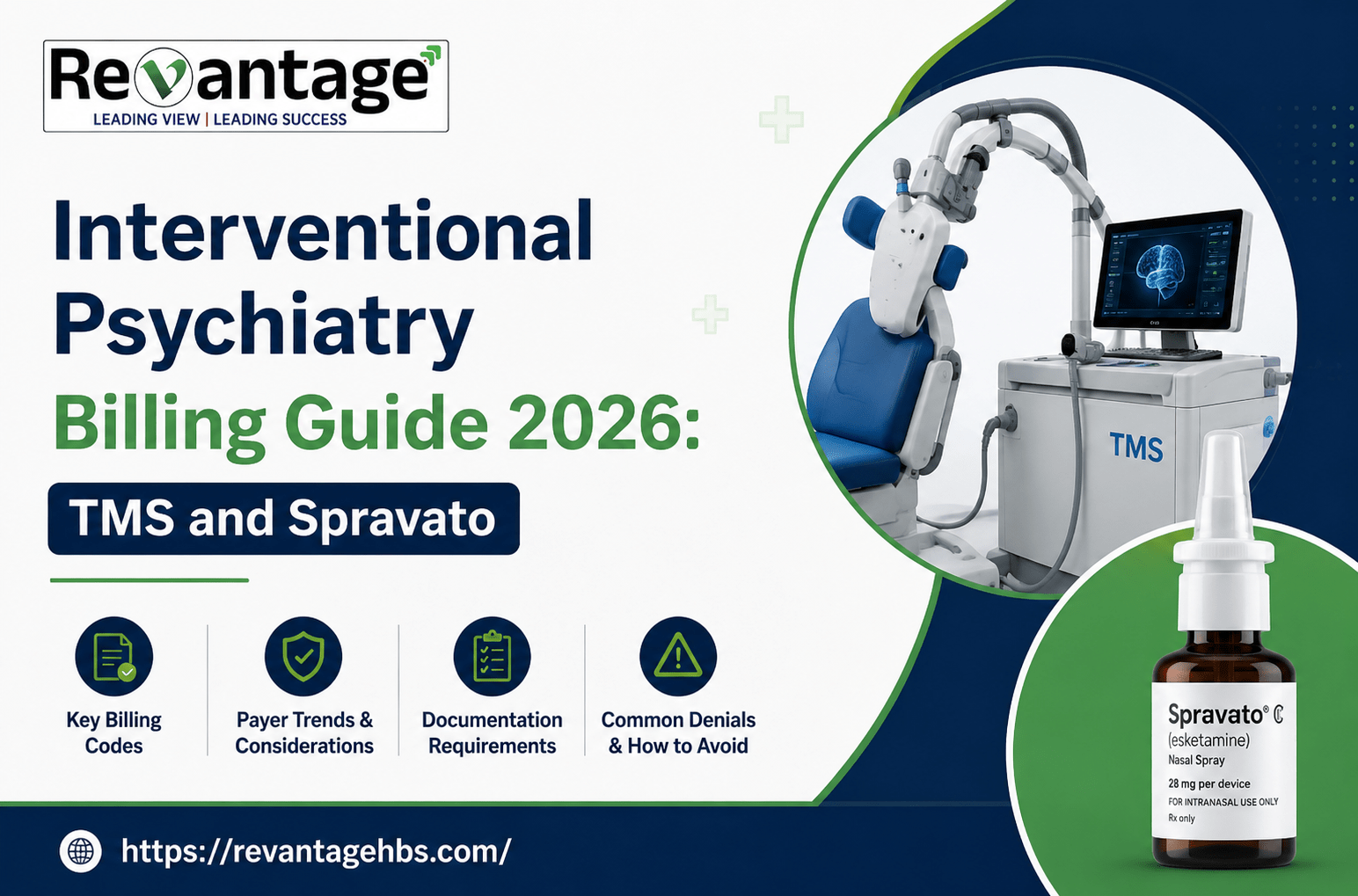
Treatment-resistant depression has become one of the most important areas of growth in behavioral healthcare. As providers expand beyond traditional medication management, they increasingly incorporate treatments such as Transcranial Magnetic Stimulation (TMS) and esketamine nasal spray (Spravato) into care plans for appropriately selected patients.
While these therapies create new opportunities to improve patient outcomes, they also introduce unique billing, coding, authorization, and compliance challenges. Revenue cycle teams must navigate payer-specific coverage policies, CPT and HCPCS coding requirements, prior authorization workflows, and evolving reimbursement guidance.
In 2026, one of the most significant developments affecting behavioral health billing is the transition from HCPCS code S0013 to J0013 for esketamine. Combined with increasing payer scrutiny of behavioral health spending, this change has highlighted the importance of accurate coding, documentation, and authorization management.
For behavioral health organizations considering TMS or Spravato services, understanding the reimbursement landscape is just as important as understanding the clinical workflow.
Why Interventional Psychiatry Matters in 2026
Interventional psychiatry continues to gain traction as behavioral health providers seek additional treatment options for patients who have not responded adequately to conventional therapies.
Several state Medicaid programs and commercial payers have expanded coverage policies for TMS in recent years, improving patient access while increasing administrative complexity. At the same time, payers continue to strengthen documentation standards, medical necessity requirements, and utilization management controls.
The result is a reimbursement environment where broader coverage does not automatically translate into easier billing.
Strong coding, authorization, and documentation processes help behavioral health practices capture reimbursement more effectively and reduce preventable denials.
Two Treatments, Two Distinct Billing Models
Providers often classify TMS and Spravato under interventional psychiatry, but each treatment follows a different billing structure.
Behavioral health providers report TMS using CPT codes throughout the treatment course as a device-based procedure. Spravato is a medication-based therapy that involves HCPCS coding, REMS-related requirements, and payer-specific reimbursement pathways.
While code sets, payer rules, and operational risks vary, the core challenge remains the same: providers must carefully manage authorization requirements, documentation standards, and payer-specific billing rules throughout treatment.
TMS Billing: CPT 90867, 90868, and 90869
| CPT Code | Description | Typical Use |
| 90867 | Initial TMS treatment, including cortical mapping, motor threshold determination, and first treatment | Reported once at treatment initiation |
| 90868 | Subsequent TMS treatment delivery and management | Reported for follow-up treatment sessions |
| 90869 | Re-determination of motor threshold with treatment delivery and management | Reported when clinically indicated and appropriately documented |
Medical Necessity Considerations
Coverage requirements vary by payer. Medicare and commercial plans may use different diagnosis criteria, treatment history requirements, and documentation standards.
Many payers require documentation demonstrating treatment-resistant depression, including evidence of prior antidepressant treatment attempts. Some plans may also require documentation of psychotherapy or other behavioral health interventions before authorizing TMS.
Because diagnosis requirements vary, providers should always verify the current payer policy before billing.
Prior Authorization Requirements
Prior authorization is common for TMS services, although requirements differ by payer and health plan.
Common authorization requirements may include:
- Documentation of failed antidepressant treatment trials
- Clinical evaluation supporting treatment-resistant depression
- Supporting psychiatric records
- Authorized session limits and treatment dates
Practices should verify approved session counts and monitor authorization expiration dates throughout the treatment course.
Common TMS Denial Triggers
- Treatment initiated before authorization approval
- Incorrect use of CPT 90867, 90868, or 90869
- Billing services outside authorized treatment limits
- Missing documentation supporting medical necessity
- Diagnosis codes that do not meet payer-specific coverage criteria
- Failure to obtain required reauthorization when applicable
Spravato (Esketamine) Billing in 2026
One of the most important coding developments affecting behavioral health billing in 2026 is the replacement of HCPCS code S0013 with J0013 for esketamine nasal spray.
Effective January 1, 2026, HCPCS code J0013 replaced the discontinued S0013 code. However, implementation has not been identical across all payers, resulting in continued claim denials and reimbursement delays for some organizations.
Understanding J0013
J0013 represents esketamine nasal spray and is generally reported per milligram administered when required by the applicable payer.
Providers should verify:
- Payer acceptance of J0013
- Authorization requirements tied to J0013
- Drug reimbursement methodology
- Billing instructions specific to the health plan
Medicare Considerations
Medicare billing for esketamine requires special attention.
Depending on the claim pathway and payer requirements, Medicare-related billing may involve the bundled G-codes G2082 and G2083, which incorporate the applicable esketamine treatment components, including required observation services.
Providers should verify Medicare Administrative Contractor (MAC) guidance and payer-specific billing instructions before claim submission.
Authorization Transition Challenges
Many denials associated with the J0013 transition stem from authorization mismatches rather than coding errors.
Common issues include:
- Existing authorizations still tied to S0013
- Payer systems that implemented updates at different times
- Authorization records not automatically migrated
- Inconsistent payer-specific billing instructions
Practices should review authorization records carefully whenever a payer transitions from one billing code to another.
REMS Requirements and Documentation
Spravato treatment is subject to FDA Risk Evaluation and Mitigation Strategy (REMS) requirements.
Providers should maintain documentation supporting:
- Administration within an eligible treatment setting
- Required monitoring and observation protocols
- Drug dosage administered
- Clinical documentation supporting treatment
Incomplete documentation can contribute to delayed reimbursement or claim denials even when coding is accurate.
What About J3490?
Some payers may issue alternative billing instructions when implementing new drug codes.
However, J3490 should not be treated as an automatic substitute for J0013. Providers should follow payer-specific written guidance before submitting claims using an unclassified drug code.
TMS vs. Spravato Billing at a Glance
| Category | TMS | Spravato |
| Primary Codes | CPT 90867, 90868, 90869 | J0013 and payer-specific billing pathways |
| Treatment Type | Device-based procedure | Medication-based treatment |
| Authorization | Commonly required | Commonly required |
| Documentation Focus | Medical necessity and treatment history | Medical necessity, dosage, and REMS-related requirements |
| Operational Risk | Session tracking and authorization limits | Drug coding transitions and authorization management |
What This Means for Behavioral Health Practices
As interventional psychiatry services continue to expand, reimbursement success increasingly depends on operational readiness.
Behavioral health organizations should focus on:
- Maintaining payer-specific authorization workflows
- Monitoring coding updates and reimbursement changes
- Strengthening clinical documentation processes
- Tracking treatment sessions and authorization limits
- Managing payer transitions proactively
Organizations that treat revenue cycle management as an integral part of service delivery are better positioned to reduce denials and improve reimbursement outcomes.
How Revantage Healthcare Business Solutions Supports Behavioral Health Practices
Interventional psychiatry billing requires coordination across coding, prior authorization, payer enrollment, credentialing, denial management, and revenue cycle operations.
Revantage Healthcare Business Solutions LLC helps behavioral health organizations navigate these challenges through specialized support for behavioral health reimbursement workflows, coding accuracy, authorization management, and payer compliance.
For practices adding or expanding TMS and Spravato services, Revantage’s Behavioral Health Billing Services, Prior Authorization support, and Credentialing & Enrollment services help providers maintain clean claims, reduce denials, and strengthen revenue performance.
Frequently Asked Questions
What is the current HCPCS code for Spravato (esketamine)?
J0013 replaced S0013 effective January 1, 2026. Billing requirements may vary by payer, and Medicare-related claims may involve G2082 or G2083 depending on the applicable billing pathway.
Do TMS and Spravato require prior authorization?
Prior authorization is common for both services, although requirements vary by payer, plan, diagnosis, and coverage policy.
What ICD-10 codes support medical necessity for TMS?
Diagnosis requirements vary by payer. Providers should verify current payer-specific coverage policies and documentation requirements before submitting claims.
Can TMS be billed for anxiety?
Coverage policies generally focus on treatment-resistant major depressive disorder and other approved indications. Providers should review the payer’s current medical policy before billing.
Why might a Spravato claim deny even when J0013 is used correctly?
Potential causes include authorization issues, payer implementation delays, documentation deficiencies, or payer-specific billing requirements.
How many sessions are included in a typical TMS treatment course?
Treatment schedules vary by clinical protocol and payer requirements. Many courses involve multiple sessions delivered over several weeks.
Compliance Disclaimer
This article is intended for educational and informational purposes only and does not constitute billing, coding, legal, or reimbursement advice. CPT, HCPCS, ICD-10, authorization, and payer policy requirements change frequently and vary by payer, plan, and jurisdiction. Providers should verify current requirements with applicable payers, Medicare contractors, and official policy sources before submitting claims.
Conclusion
Interventional psychiatry continues to play an increasingly important role in behavioral healthcare, but expanding access does not eliminate reimbursement complexity. TMS and Spravato each require distinct billing, authorization, documentation, and compliance workflows.
Organizations that proactively manage coding updates, authorization requirements, and payer-specific billing rules are better positioned to reduce denials and improve revenue performance. As reimbursement requirements continue to evolve throughout 2026, behavioral health practices should ensure their revenue cycle processes evolve alongside them.
Connect with Revantage Healthcare Business Solutions LLC to strengthen behavioral health revenue cycle performance, improve compliance, and support long-term growth.