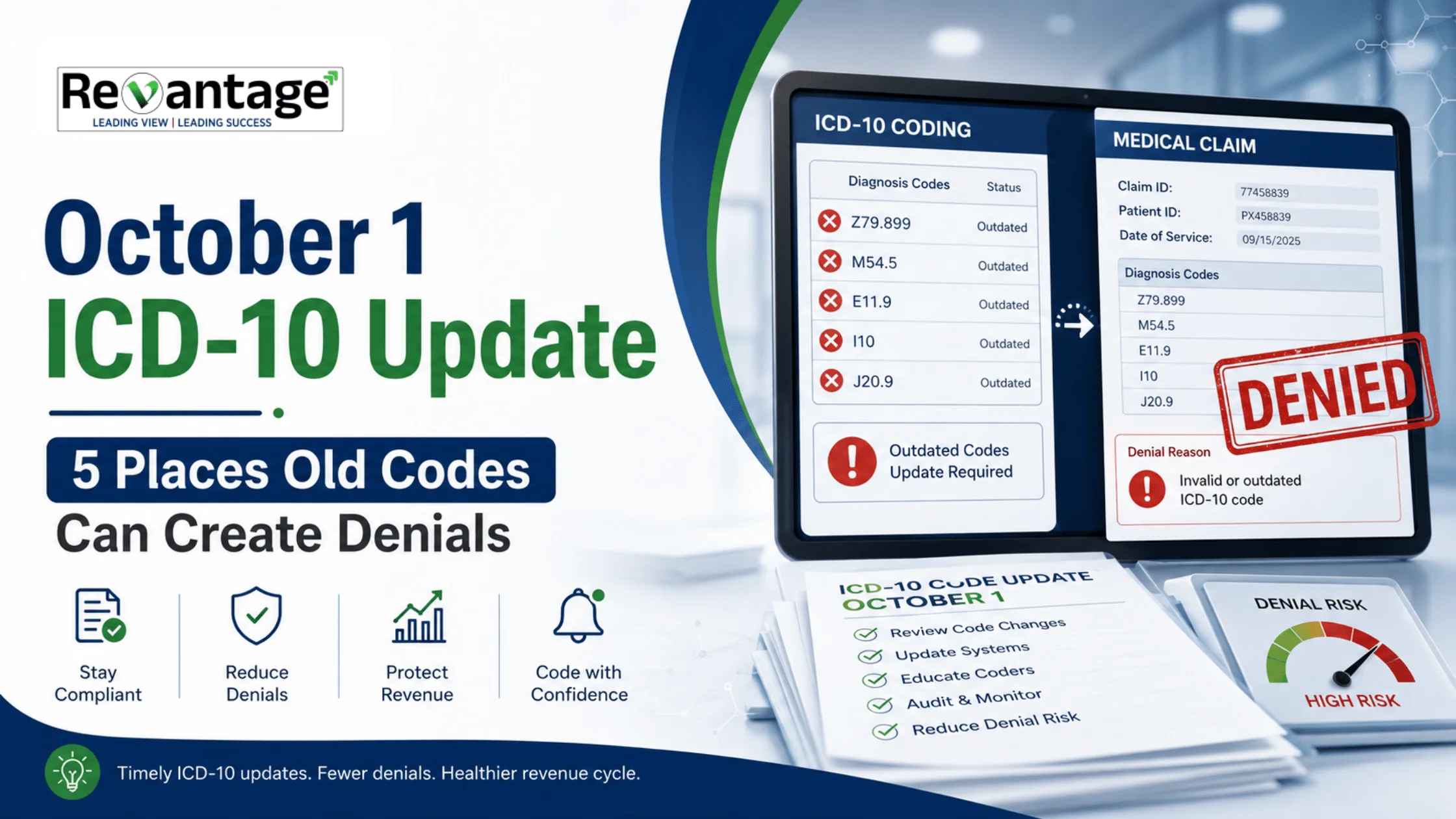
Most ICD-10 denials that appear in October are not caused by complicated coding decisions. They are usually caused by an old code sitting somewhere no one thought to check.
The FY 2027 ICD-10-CM update takes effect October 1, 2026. The new diagnosis codes apply to patient encounters from October 1, 2026, through September 30, 2027. For inpatient facilities, the update also applies to qualifying discharges beginning October 1.
That gives practices a clear deadline, but downloading the new code file is only one part of the work. Codes can appear in clinical, authorization and billing systems far beyond the main coding database.
Here are five places practices should review before October 1.
1. EHR Favorites and Problem Lists
Updating the main ICD-10 database does not always update the codes saved inside provider favorites, problem lists and clinical templates.
A physician may continue selecting a familiar diagnosis without realizing that the code has been deleted, replaced or expanded into more specific options.
This can lead to:
- Invalid diagnosis code denials
- Use of an outdated or deleted code
- Requests for more specific information
- A diagnosis that no longer supports the service billed
Run a report of frequently used diagnoses by provider and specialty. Compare those codes with the FY 2027 addendum and conversion table. High-volume codes should be reviewed first.
Providers should also be told when a familiar code has changed. A technically updated EHR will not help if the provider continues selecting an old diagnosis from a saved template. For related guidance on maintaining coding accuracy during annual revisions, review the 2025 coding updates resource.
2. Superbills and Charge-Capture Templates
Paper superbills, electronic encounter forms and specialty-specific charge templates are easy to overlook.
Many practices update these documents only when someone reports a problem. By that point, the old code may already have appeared on several claims.
Review any document or screen where staff can select a diagnosis, including:
- Paper encounter forms
- EHR charge-capture screens
- Surgical scheduling forms
- Therapy plans
- Lab and imaging order templates
- Mobile charge-capture applications
Do not simply replace a deleted code with the first available alternative. A replacement may require additional documentation, laterality, severity, encounter type or another clinical detail that was not previously captured.
The template and the documentation workflow must be updated together. Strong medical billing and coding processes help ensure that clinical documentation supports the diagnosis selected on the claim.
3. Prior Authorization and Referral Workflows
An authorization approved before October 1 may contain a diagnosis code that is no longer valid for services performed after the update.
The clinical service may still be authorized, but the claim can be denied when the diagnosis submitted on the claim does not match the code stored in the payer’s authorization record.
This is especially important for services involving:
- Repeated treatments
- Therapy plans
- Diagnostic imaging
- Scheduled procedures
- Specialty medications
- Ongoing treatment authorizations
Before changing the diagnosis on an authorized service, confirm whether the payer requires the authorization to be updated.
Keep a record of the payer representative, reference number, and any instructions received. Do not assume that the payer’s authorization system will automatically convert the old diagnosis. Effective prior authorization services can help reduce authorization-related claim delays and denials.
4. Medical-Necessity and Payer Policy Crosswalks
A diagnosis code can be valid and still result in a denial.
Medicare coverage policies and commercial payer guidelines often contain diagnosis-to-procedure relationships. When a code is deleted or replaced, the corresponding medical-necessity list must also be updated.
Practices should review:
- Medicare LCD and NCD diagnosis lists
- Commercial payer medical policies
- Internal procedure-to-diagnosis crosswalks
- Laboratory medical-necessity tools
- Imaging order rules
- Specialty drug coverage policies
A new diagnosis may accurately describe the patient’s condition but may not yet appear in the payer’s coverage policy.
If that happens, do not automatically return to an outdated code. Confirm the effective policy, review the documentation, and contact the payer when its system appears to be using an older code set.
5. Billing Systems, Claim Scrubbers, and Denial Workqueues
The billing system may be updated while a connected claim scrubber, clearinghouse, or custom billing rule continues using the previous code set.
This creates two possible problems.
The system may reject a valid new code because it does not recognize it. More concerning, it may allow an invalid code through without warning, leaving the payer to deny the claim later.
Review every system that touches the diagnosis before the claim reaches the payer:
- Practice management software
- Claim scrubbers
- Clearinghouses
- Interface engines
- Custom billing edits
- Automated charge-entry tools
- Denial and appeal templates
- Reporting and analytics systems
Denial workqueues should also be updated. Staff should not receive an automated correction recommendation that sends the claim back with a retired diagnosis. Teams can also use claim denial reason codes to support more consistent denial analysis and correction workflows.
The Date of Service Matters
The new ICD-10-CM codes are tied to the patient encounter date, not the date the claim is submitted.
A September 30 service and an October 1 service may require different code sets even when both claims are submitted on the same day.
Billing teams should be careful when handling late charges, corrected claims, and claims that cross the October 1 transition. Inpatient facilities should separately confirm the applicable discharge-date requirements.
A Practical Readiness Plan
Practices do not need to wait until the last week of September.
Start by identifying the diagnosis codes used most frequently during the previous 12 months. Concentrate on the codes connected to high-volume procedures, prior authorization, and medical-necessity policies.
Then:
- Load the FY 2027 files into a test environment.
- Review deleted, added, and revised codes affecting the practice’s specialties.
- Update EHR templates, superbills, and authorization tools.
- Test sample claims with October 1 dates of service.
- Confirm that clearinghouse and claim-scrubber updates are complete.
- Monitor invalid-code and medical-necessity denials daily after implementation.
The first two weeks of October deserve closer attention. A small increase in diagnosis-related denials can quickly turn into a larger accounts receivable problem if the cause is spread across multiple systems.
The Bottom Line
October 1 is not only a coding department deadline.
The update affects providers, front-desk teams, authorization specialists, billers, clearinghouses, and payer-policy workflows. One outdated code in any part of that chain can delay an otherwise payable claim.
A short review before October 1 is far less expensive than correcting hundreds of claims afterward.
At Revantage Healthcare, we review ICD-10 changes across the full revenue cycle management process, from clinical documentation and authorization through claim submission and denial management. The goal is simple: find the outdated code before the payer does.